
Showing posts with label medieval. Show all posts
Showing posts with label medieval. Show all posts
Who's Who in Medieval Brittany
I know this is perhaps is not as pressing to some people as it is to me, but if you have ever wanted to get a good look at the dukes of Brittany of the Middle Ages, you might have discovered that no good tree exists--at least not in a single, easy-to-find format. So, since I spent an inordinate amount of time the other day finally making one, I thought I would put it up here in the vague hopes that it might be useful to some desperate searcher on the internet some day. Not guaranteed 100% complete, but a good start. (Click on the picture for a fuller version, and if you want to use this image please give credit).

Well, where would YOU keep it?
Enough ranting lately, so I'm going to start doing something I've always wanted to do and post pictures of odd street names I've run across. We'll start with one from Dinan, my favorite little medieval Breton town (it's lovely, you should absolutely go):
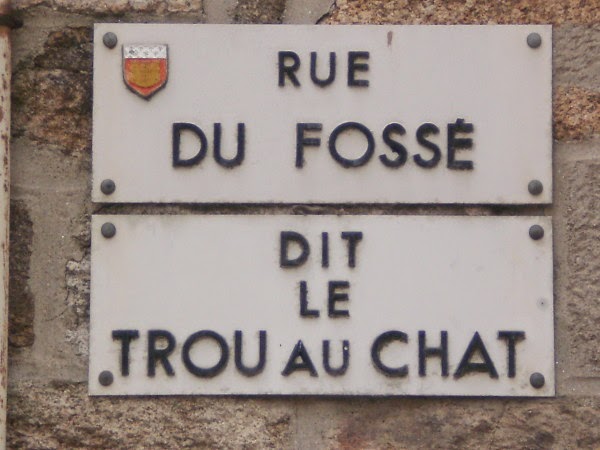
This means "Street of the ditch, called the Cat's Hole".
It opens through the town walls, hence the ditch or moat. But there are no felines running around here. A "chat" or cat was a kind of siege engine which protected men from missiles thrown above and was thus good for getting close to walls (I've got a 16th-century text here describing a 14th-century battle, which also has the cats serving "as towers for throwing rocks against the walls"; take that as you will). So this street was where you kept your cat when it wasn't in use.
This means "Street of the ditch, called the Cat's Hole".
It opens through the town walls, hence the ditch or moat. But there are no felines running around here. A "chat" or cat was a kind of siege engine which protected men from missiles thrown above and was thus good for getting close to walls (I've got a 16th-century text here describing a 14th-century battle, which also has the cats serving "as towers for throwing rocks against the walls"; take that as you will). So this street was where you kept your cat when it wasn't in use.
"Medieval" witchcraft
So, this morning, I saw an article shared about how a woman was beaten to death after being accused of witchcraft on Facebook.
That's horrifying and horrible. There's no real reason to comment further on that, because it's obvious.
It does seem as good a place as any to start documenting and addressing misuses of the word "medieval" in the public discourse.
To anyone who is a historian, or hangs around with medievalists, or whatever, this is not a new peeve,* nor do I intend to highlight anything particularly new--if only because the uses are so entirely predictable. The term medieval, in newspaper-speak, always refers to "backwards", "barbaric", "evil", and so on. Honestly, it's not very interesting. However, it's worth pointing out specific instances where the Middle Ages are being abused, in the hopes that someone, somewhere, will learn something concrete about history. And so I can let out some steam.
In this instance, of course, I didn't even have to click on the article itself to confirm my suspicion that it would be misusing its historical comparisons. The tagline itself talked about "going back to the Middle Ages".
Well, funny fact: what you really meant, more or less, is "going back to the Renaissance".
See, while witchcraft has often been more or less prevalent as a known element of society--this is pretty much true, in different guises, for most of European history--it didn't really become an issue until after the Protestant Reformation.
There were inquisitions before then, because of all those pesky heretics running around; but they were annoyed by rather than interested in accusations of witchcraft. They would tell the accusers to go away, basically. It wasn't pretend uses of magic that bothered them, it was issues of theology. If you hear about someone being burnt in the Middle Ages, most probably it's for religious (mis)beliefs, not for magic. This is not to say "witches" never got into trouble--but actually, mostly people just kind of accepted witchcraft in the background.
But the security of Catholicism was shaken up by the advent of the Protestants, and that's where things started to get ugly. A group on the defensive is far more dangerous than one that feels confident in its place: just look at evangelical Christians in American society today. Now witchcraft, on one side of the religious line or the other, could join heresy in the array of fear and justification for violent action.
The date of the Salem witch trials? 1692-3. That's so not medieval it isn't even funny. And that's just the most famous example. Heck, even going onto Wikipedia produces very interesting results. In the article Witchcraft, under History: Europe, the very first sentence begins "In Early Modern European tradition..." Medieval witchcraft wasn't a thing; the most famous treatise on the prosecution of witches is late 15th-century. And, interestingly, the Spanish Inquisition dealt much less with witches than any other inquisition in, say, France or Germany: Catholicism was much less challenged by Protestantism there, so no one needed to be as bothered.
I don't intend to outline the entire history of EM witchcraft here,** especially when it's so easy to see that simply using "medieval" to describe its modern recurrence*** is both lazy and really, really inaccurate. But we daren't say anything against the Renaissance, now do we? It wouldn't convey the same point as using medieval, which everyone knows as a bad thing... Nonsense.
Get over it, and get it right!
*Not that many medievalists aren't ignorant about surprising amounts of the period which aren't directly in their familiarity. This one is actually a particular example, so pay attention, folks.
**Although it's very easy to quickly scrounge up some internet information, Carlo Ginzburg's The Night Battles provides an excellent précis.
***Also, does the fact that these things can apparently still happen today mean that we're travelling in time? how about "society is still messed up, because that's how people are"? Just throwing it out there.
That's horrifying and horrible. There's no real reason to comment further on that, because it's obvious.
It does seem as good a place as any to start documenting and addressing misuses of the word "medieval" in the public discourse.
To anyone who is a historian, or hangs around with medievalists, or whatever, this is not a new peeve,* nor do I intend to highlight anything particularly new--if only because the uses are so entirely predictable. The term medieval, in newspaper-speak, always refers to "backwards", "barbaric", "evil", and so on. Honestly, it's not very interesting. However, it's worth pointing out specific instances where the Middle Ages are being abused, in the hopes that someone, somewhere, will learn something concrete about history. And so I can let out some steam.
In this instance, of course, I didn't even have to click on the article itself to confirm my suspicion that it would be misusing its historical comparisons. The tagline itself talked about "going back to the Middle Ages".
Well, funny fact: what you really meant, more or less, is "going back to the Renaissance".
See, while witchcraft has often been more or less prevalent as a known element of society--this is pretty much true, in different guises, for most of European history--it didn't really become an issue until after the Protestant Reformation.
There were inquisitions before then, because of all those pesky heretics running around; but they were annoyed by rather than interested in accusations of witchcraft. They would tell the accusers to go away, basically. It wasn't pretend uses of magic that bothered them, it was issues of theology. If you hear about someone being burnt in the Middle Ages, most probably it's for religious (mis)beliefs, not for magic. This is not to say "witches" never got into trouble--but actually, mostly people just kind of accepted witchcraft in the background.
But the security of Catholicism was shaken up by the advent of the Protestants, and that's where things started to get ugly. A group on the defensive is far more dangerous than one that feels confident in its place: just look at evangelical Christians in American society today. Now witchcraft, on one side of the religious line or the other, could join heresy in the array of fear and justification for violent action.
The date of the Salem witch trials? 1692-3. That's so not medieval it isn't even funny. And that's just the most famous example. Heck, even going onto Wikipedia produces very interesting results. In the article Witchcraft, under History: Europe, the very first sentence begins "In Early Modern European tradition..." Medieval witchcraft wasn't a thing; the most famous treatise on the prosecution of witches is late 15th-century. And, interestingly, the Spanish Inquisition dealt much less with witches than any other inquisition in, say, France or Germany: Catholicism was much less challenged by Protestantism there, so no one needed to be as bothered.
I don't intend to outline the entire history of EM witchcraft here,** especially when it's so easy to see that simply using "medieval" to describe its modern recurrence*** is both lazy and really, really inaccurate. But we daren't say anything against the Renaissance, now do we? It wouldn't convey the same point as using medieval, which everyone knows as a bad thing... Nonsense.
Get over it, and get it right!
*Not that many medievalists aren't ignorant about surprising amounts of the period which aren't directly in their familiarity. This one is actually a particular example, so pay attention, folks.
**Although it's very easy to quickly scrounge up some internet information, Carlo Ginzburg's The Night Battles provides an excellent précis.
***Also, does the fact that these things can apparently still happen today mean that we're travelling in time? how about "society is still messed up, because that's how people are"? Just throwing it out there.
Directions for Research (or, Why Everyone in History Has the Same Name)
(With excuses to those who have already seen this topic elsewhere).
Another ongoing theme from my own research is the fact that everyone I study has the same name (e.g. Jeanne de Penthièvre, Jeanne de Flandre, Jeanne de Montfort, Jean de Montfort, Jean IV de Montfort, Jean de Blois-Penthièvre, Jean III, Jean II le Bon; Charles de Blois, Charles V, Charles VI....) As a matter of fact, it appears that 25% of the nobility in Brittany was called "Jean". Meanwhile, it was common, when a lineage had been reduced to a single heiress, for her husband to be required to take up the family first name of his spouse, to carry it on;* and a couple would happily name more than one child that simultaneously, as did certain dukes of Brittany. And even if a child may have originally had a different first name, upon their inheritance it might well "revert"; Duke Jean V was Pierre until 1399.
This stream of discoveries prompted some of my friends to propose a new avenue for future research, which, in its edited form, I have decided to reproduce here in order to stimulate a broader historical community:
One of the most under-researched aspects of the fourteenth century is the chronic first name shortage. Feudal lords responded by pressuring their serfs to concentrate on Jean(ne), a hardy and resilient name crop which was intended to prevent identity famine. However, the resulting overproduction led to a surplus which caused, and continues to cause, a gret deal of confusion. The effects of this "name poverty" and associated strife are particularly striking in Brittany of the period, but in this they were reflecting the longstanding trend in increasing first-name poverty within the French monarchy. Whereas under the Merovingian kings name innovation was at its peak, under the Carolingians name repetition increased perceptibly. Full repetitive name disorder, however, did not develop until the Capetians, after whom virtually all French kings were called Louis, Philip, or Charles. By the fourteenth century, the name event horizon had been passed and all kings for all intents and purposes became the same person. Even the desperate attempt to introduce new names such as 'Henry', 'Jean', and 'François' were thoroughly unsuccessful. Name confusion of this kind resulted in increasing social and political unrest. Although the trend of name poverty amongst the serfs was a passing phase, it became increasingly institutionalized in the French monarchy. With the growing social mobility of the mercantile classes, the gap in name density between the two social levels became more apparent. The lack of name-variation dehumanized the monarchy and soon became a symbol of social repression, the more rigid name-systems of the aristocracy opposing the innovative name-culture brought about by the budding third estate. The situation reached a breaking point with a chain of for Kings 'Louis' from 1610-1792, which culminated in the French Revolution.
In case some people might be confused, this is entirely spurious; the trends highlighted are for the most part entirely false. However, what makes it work so well for me is that the idea of a title-holder "for all intents and purposes" being the same person is, in fact, exactly what the idea was, especially as the monarchy transformed into something superior to the individual holder of the role. Hidden truths...
And for the record, some historians seem hell-bent on calling Duke Jean IV of Brittany Jean V, his son Jean VI, and his father Jean IV (he never actually had any number, not being a duke). FOR THE LOVE OF ALL WE HOLD DEAR, PLEASE STOP. The numbers are all we have to save us from the madness. Leave them alone.
That is all.
*Philippe Contamine gives an impressive list of "family first names"; for instance, sons of the Laval family (in Brittany) took the name Guy, those of the Coucy family were Enguerran, and so on. Meanwhile, the husband of Anne de Laval, formerly known as Jean de Montfort, was required to become "Guy de Laval", making him the thirteenth of that name after Anne's father, the twelfth--and if he refused the name, he would be subject to a fine of 100,000 livres! (see La noblesse au royaume de France de Philippe le Bel à Louis XII, 217-8).
Another ongoing theme from my own research is the fact that everyone I study has the same name (e.g. Jeanne de Penthièvre, Jeanne de Flandre, Jeanne de Montfort, Jean de Montfort, Jean IV de Montfort, Jean de Blois-Penthièvre, Jean III, Jean II le Bon; Charles de Blois, Charles V, Charles VI....) As a matter of fact, it appears that 25% of the nobility in Brittany was called "Jean". Meanwhile, it was common, when a lineage had been reduced to a single heiress, for her husband to be required to take up the family first name of his spouse, to carry it on;* and a couple would happily name more than one child that simultaneously, as did certain dukes of Brittany. And even if a child may have originally had a different first name, upon their inheritance it might well "revert"; Duke Jean V was Pierre until 1399.
This stream of discoveries prompted some of my friends to propose a new avenue for future research, which, in its edited form, I have decided to reproduce here in order to stimulate a broader historical community:
One of the most under-researched aspects of the fourteenth century is the chronic first name shortage. Feudal lords responded by pressuring their serfs to concentrate on Jean(ne), a hardy and resilient name crop which was intended to prevent identity famine. However, the resulting overproduction led to a surplus which caused, and continues to cause, a gret deal of confusion. The effects of this "name poverty" and associated strife are particularly striking in Brittany of the period, but in this they were reflecting the longstanding trend in increasing first-name poverty within the French monarchy. Whereas under the Merovingian kings name innovation was at its peak, under the Carolingians name repetition increased perceptibly. Full repetitive name disorder, however, did not develop until the Capetians, after whom virtually all French kings were called Louis, Philip, or Charles. By the fourteenth century, the name event horizon had been passed and all kings for all intents and purposes became the same person. Even the desperate attempt to introduce new names such as 'Henry', 'Jean', and 'François' were thoroughly unsuccessful. Name confusion of this kind resulted in increasing social and political unrest. Although the trend of name poverty amongst the serfs was a passing phase, it became increasingly institutionalized in the French monarchy. With the growing social mobility of the mercantile classes, the gap in name density between the two social levels became more apparent. The lack of name-variation dehumanized the monarchy and soon became a symbol of social repression, the more rigid name-systems of the aristocracy opposing the innovative name-culture brought about by the budding third estate. The situation reached a breaking point with a chain of for Kings 'Louis' from 1610-1792, which culminated in the French Revolution.
In case some people might be confused, this is entirely spurious; the trends highlighted are for the most part entirely false. However, what makes it work so well for me is that the idea of a title-holder "for all intents and purposes" being the same person is, in fact, exactly what the idea was, especially as the monarchy transformed into something superior to the individual holder of the role. Hidden truths...
And for the record, some historians seem hell-bent on calling Duke Jean IV of Brittany Jean V, his son Jean VI, and his father Jean IV (he never actually had any number, not being a duke). FOR THE LOVE OF ALL WE HOLD DEAR, PLEASE STOP. The numbers are all we have to save us from the madness. Leave them alone.
That is all.
*Philippe Contamine gives an impressive list of "family first names"; for instance, sons of the Laval family (in Brittany) took the name Guy, those of the Coucy family were Enguerran, and so on. Meanwhile, the husband of Anne de Laval, formerly known as Jean de Montfort, was required to become "Guy de Laval", making him the thirteenth of that name after Anne's father, the twelfth--and if he refused the name, he would be subject to a fine of 100,000 livres! (see La noblesse au royaume de France de Philippe le Bel à Louis XII, 217-8).
History... but with Dragons
First up, let me say that I am all about "history, but with dragons".
Did I mention that I'm writing a novel? Well, I am, and now I have mentioned it: and it's very much the Hundred Years' War only with some more magic, some cultural changes when I feel like it, and of course some dragons.* Shameless plug!
And that seems to be a trend right now, sort of. Not a trend like, say, "vampires" (too popular for their own good) or "plucky heroines in a dystopia"--nothing so big. But there are a lot of them nonetheless, although in some ways it's ridiculous to lump them all into one category.
For instance, my novel, like those of GRRM (though I have a distaste for lumping his work, which I have major problems with, next to my own!**), is really just "fantasy", with a historically-inspired flavor, that also likes dragons. Because dragons are awesome.
And then there are works that are much more strongly linked to actual history. At the furthest end of the spectrum are works such as Naomi Novik's Temeraire and subsequent books, which I can highly recommend. It's the Napoleonic era, only there's an Air Corps in England--because people ride dragons. Dragon-riding, of course, has been done before (because, I must reiterate, dragons are awesome--why would you not want to ride one?)***. But the historical context is new.
What does it add? Well, it's an original context for dragons, obviously, and creates a particular kind of "let's revisit history" feel not otherwise attainable. But we can also ask, what does adding dragons to history do? It serves, if you will, as a highlighter to make unfamiliar issues we're accustomed to in a purely-historical context. It heightens themes. The Napoleonic era was characterized by increasing trends of colonialization, growing contact with unfamiliar, far-off societies. On a practical level, having dragons flying about lets you visit those places much more easily! But narratively, they act as a focus for the issues arising from the colonial aspirations of Europeans. Dragons themselves are, in their way, subjugated: is this acceptable? Their relations across cultures are shaped by, but in important ways different from the ways human strangers interact: what lessons can be learned from that?
[Aside: Susanna Clarke's Jonathan Strange and Mr Norrell is also related to category, although it lacks any actual dragons, which does give it a different feel. I mention it in part because it is one of the most brilliant works of modern fantasy (the term is not meant to be ironic) I have ever read. You should read it too. Although it lacks the iconic dragon-ness, it again uses fantasy to elaborate upon historical themes (again in the Napoleonic era), especially gender balances, national myths, and the relevance of history itself. In young adult lit, Jonathan Stroud's Bartimaeus trilogy (and the fourth stand-alone book) does much the same: power is concentrated in the hands of demon-summoning magicians, whose magical power and relationships with their otherworldly servants (and the rest of society) is indicative of the problematic structures of power within an oligarchic polity.]
Most recently, I just finished Jo Walton's Tooth and Claw, which is actually a dragon society. That's cool: when was the last time you actually had an entire civilization of dragons, rather than dragons simply incorporated into human society? More specifically, that society is, with the necessary changes to accommodate dragon-ness, essentially early/mid-nineteenth-century England. There were humans in the past, and they still exist somewhere in the world, but are almost entirely physically absent from the story, and the dragon culture gets along just fine without them. Within their own sphere, then, the familial dynamics and social structures reflect values of our real historical time (including tensions between Protestants and Catholics, uncomfortable relations with the serving classes, and gender roles) but heighten them through the unfamiliarity of having it all be done by hat-wearing dragons. It makes you take notice of the underlying mechanics much more aggressively (though this is not to say that they cannot become evident in other historicizing genres, of course!).
[Second aside: Interestingly, the Novik books also have at least one dragon society (I have only read the first six, after which they no longer had pretty covers and are hard to find in England): in the heartlands of the African continent--I'm guessing it's the Great Rift Valley, but that could be entirely wrong--there are a group of dragons living without contact with humans. That opened up yet another social model with which to compare the human-dragon society.]
I have always felt that dragons (and, in fact, elves/fairies/whatnot) are most interesting insofar as they stem from different elements within the human disposition. Dragons, in addition to being awesome, are often the embodiment of negative human tendencies such as greed, violence, or a lust for power. (I explore this in a short story, The Price of Gold. Oops, second plug!). Clarke's fairies embody human actors in very much a historical mode, but without an essential element of human compassion; this makes them both familiar and unsettling.
This is not a particularly new observation in itself: myths and legends have long tended to be analyzed in terms of projecting our own fears, hopes, worries, etc. on an imaginary prospect. I do find it interesting that this is often tied (and has been tied for a good while) onto specific historical moments, as if dragons and their fantasy friends actually belong most in a familiar world, to shake it up and make it into something new. There also seems to be a preponderance of 19th-century settings, which is significant in itself (even the more modern Stroud books rely heavily on the impact of the great magician Gladstone, and Britain still functions in the mode of an Empire): a moment when society shifted away from what it had been**** and had to be redefined, with good options and bad.
Dragons, perhaps even more so than other fantastic creatures, can exemplify these choices in society. Because nothing sends a message across like a creature that mirrors our own concerns, but wears wings and breathes fire.
*It's called The Gates of Yesterday and can be read on-line (still in-progress) if you drop me a line to give you access.
**Hubris!
***Oh right. That would be epically dangerous. Also, they are not real.
****The telescope of history strikes again in our obsession with this.
[Edit: I just remembered that, in France, Pierre Pevel has a trilogy that also does the dragons-in-history thing--in the Paris of Louis XIII this time, so it's kind of a fantastic Alexandre Dumas. To a degree that one's more literary in character, in that it's goal is more reimagining the Three Musketeers only with a magical twist rather than working directly with the historical situation proper. On the other hand, recasting the power balances of Europe as manipulated by dragons could be a fair analogy. Still, since the dragons are not the actual figures of political power--in that, say, Richelieu is not a dragon, nor are any of the Spanish leaders with which France was, at the time, at war--the feel is different; frankly, the dragons feel more like an intrusion into the historical world (however literary and dramatized it may be) than the ones which fulfill a more integrated, social role. Still, they're quite a fun read (everyone loves a musketeer...).]
Did I mention that I'm writing a novel? Well, I am, and now I have mentioned it: and it's very much the Hundred Years' War only with some more magic, some cultural changes when I feel like it, and of course some dragons.* Shameless plug!
And that seems to be a trend right now, sort of. Not a trend like, say, "vampires" (too popular for their own good) or "plucky heroines in a dystopia"--nothing so big. But there are a lot of them nonetheless, although in some ways it's ridiculous to lump them all into one category.
For instance, my novel, like those of GRRM (though I have a distaste for lumping his work, which I have major problems with, next to my own!**), is really just "fantasy", with a historically-inspired flavor, that also likes dragons. Because dragons are awesome.
And then there are works that are much more strongly linked to actual history. At the furthest end of the spectrum are works such as Naomi Novik's Temeraire and subsequent books, which I can highly recommend. It's the Napoleonic era, only there's an Air Corps in England--because people ride dragons. Dragon-riding, of course, has been done before (because, I must reiterate, dragons are awesome--why would you not want to ride one?)***. But the historical context is new.
What does it add? Well, it's an original context for dragons, obviously, and creates a particular kind of "let's revisit history" feel not otherwise attainable. But we can also ask, what does adding dragons to history do? It serves, if you will, as a highlighter to make unfamiliar issues we're accustomed to in a purely-historical context. It heightens themes. The Napoleonic era was characterized by increasing trends of colonialization, growing contact with unfamiliar, far-off societies. On a practical level, having dragons flying about lets you visit those places much more easily! But narratively, they act as a focus for the issues arising from the colonial aspirations of Europeans. Dragons themselves are, in their way, subjugated: is this acceptable? Their relations across cultures are shaped by, but in important ways different from the ways human strangers interact: what lessons can be learned from that?
[Aside: Susanna Clarke's Jonathan Strange and Mr Norrell is also related to category, although it lacks any actual dragons, which does give it a different feel. I mention it in part because it is one of the most brilliant works of modern fantasy (the term is not meant to be ironic) I have ever read. You should read it too. Although it lacks the iconic dragon-ness, it again uses fantasy to elaborate upon historical themes (again in the Napoleonic era), especially gender balances, national myths, and the relevance of history itself. In young adult lit, Jonathan Stroud's Bartimaeus trilogy (and the fourth stand-alone book) does much the same: power is concentrated in the hands of demon-summoning magicians, whose magical power and relationships with their otherworldly servants (and the rest of society) is indicative of the problematic structures of power within an oligarchic polity.]
Most recently, I just finished Jo Walton's Tooth and Claw, which is actually a dragon society. That's cool: when was the last time you actually had an entire civilization of dragons, rather than dragons simply incorporated into human society? More specifically, that society is, with the necessary changes to accommodate dragon-ness, essentially early/mid-nineteenth-century England. There were humans in the past, and they still exist somewhere in the world, but are almost entirely physically absent from the story, and the dragon culture gets along just fine without them. Within their own sphere, then, the familial dynamics and social structures reflect values of our real historical time (including tensions between Protestants and Catholics, uncomfortable relations with the serving classes, and gender roles) but heighten them through the unfamiliarity of having it all be done by hat-wearing dragons. It makes you take notice of the underlying mechanics much more aggressively (though this is not to say that they cannot become evident in other historicizing genres, of course!).
[Second aside: Interestingly, the Novik books also have at least one dragon society (I have only read the first six, after which they no longer had pretty covers and are hard to find in England): in the heartlands of the African continent--I'm guessing it's the Great Rift Valley, but that could be entirely wrong--there are a group of dragons living without contact with humans. That opened up yet another social model with which to compare the human-dragon society.]
I have always felt that dragons (and, in fact, elves/fairies/whatnot) are most interesting insofar as they stem from different elements within the human disposition. Dragons, in addition to being awesome, are often the embodiment of negative human tendencies such as greed, violence, or a lust for power. (I explore this in a short story, The Price of Gold. Oops, second plug!). Clarke's fairies embody human actors in very much a historical mode, but without an essential element of human compassion; this makes them both familiar and unsettling.
This is not a particularly new observation in itself: myths and legends have long tended to be analyzed in terms of projecting our own fears, hopes, worries, etc. on an imaginary prospect. I do find it interesting that this is often tied (and has been tied for a good while) onto specific historical moments, as if dragons and their fantasy friends actually belong most in a familiar world, to shake it up and make it into something new. There also seems to be a preponderance of 19th-century settings, which is significant in itself (even the more modern Stroud books rely heavily on the impact of the great magician Gladstone, and Britain still functions in the mode of an Empire): a moment when society shifted away from what it had been**** and had to be redefined, with good options and bad.
Dragons, perhaps even more so than other fantastic creatures, can exemplify these choices in society. Because nothing sends a message across like a creature that mirrors our own concerns, but wears wings and breathes fire.
*It's called The Gates of Yesterday and can be read on-line (still in-progress) if you drop me a line to give you access.
**Hubris!
***Oh right. That would be epically dangerous. Also, they are not real.
****The telescope of history strikes again in our obsession with this.
[Edit: I just remembered that, in France, Pierre Pevel has a trilogy that also does the dragons-in-history thing--in the Paris of Louis XIII this time, so it's kind of a fantastic Alexandre Dumas. To a degree that one's more literary in character, in that it's goal is more reimagining the Three Musketeers only with a magical twist rather than working directly with the historical situation proper. On the other hand, recasting the power balances of Europe as manipulated by dragons could be a fair analogy. Still, since the dragons are not the actual figures of political power--in that, say, Richelieu is not a dragon, nor are any of the Spanish leaders with which France was, at the time, at war--the feel is different; frankly, the dragons feel more like an intrusion into the historical world (however literary and dramatized it may be) than the ones which fulfill a more integrated, social role. Still, they're quite a fun read (everyone loves a musketeer...).]
A Fourteenth-Century Guide to Hairshirts (or, Everything You Never Wanted to Know about Wearing Your Cilice)
In 1371 at the canonization trial for Charles de Blois, duke of Brittany from 1341-1364 (when he died in a battle), much was made of hairshirts.* In it, I apparently counted and logged 44 references before giving up with an "etc." They have since become a constant theme of my research, which is weird. So, for my convenience and especially for any pious reader who might want to deck themselves out with this latest religious fashion accessory, here is what this source tells us about hairshirts--tips and tricks for the savvy devotee.
*Sérent, Antoine de. Monuments du Procès de Canonisation du Bienheureux Charles de Blois, Duc de Bretagne, 1320-1364. Saint-Brieuc: R. Prud'homme, 1921. All page numbers representative--the same information can be found repeatedly.
**A piece of Charles' hairshirt was in fact among the possessions of his widow, Jeanne de Penthièvre, upon her death in 1384 (see Arthur le Moyne de la Borderie, Inventaire du mobilier de Jeanne la Boîteuse, duchesse de Bretagne (1384). Nantes: Guéraud et Cie, 1854).
- Horsehair makes them appropriately scratchy (p. 107).
- It can be elegantly concealed beneath your clothes for a "private devotion" look. Only if your servants see you undress (p. 38) or happen to feel it through your outer clothing (p. 66) will anyone find out.
- Swear them to secrecy, it's only modest. But they'll tell everyone, so you can enjoy a good reputation! (p. 39)
- You have an exciting range of color choices: match your clothes with a hairshirt in red, black, or plain white (p. 76).
- The really good ones can be bought in Paris (p. 48).
- If you're feeling extra-charitable, you can give your old hairshirt (or a new one) to a deserving recluse (p. 52). Bonus points (but don't forget about that "secrecy" thing).
- And if people think it's strange that you have so many lying around, lie and say they're for someone else (p. 71).
- Warning: make sure to take it off before going to bed at night with your wife (p. 79). She may not share all your habits, and may not appreciate the fleas (p. 163). In fact, it's probably best if she just doesn't know you have one (p. 107).
- But she'll be really pleased to find you've stored some away in the treasure chests instead of gold (p. 121).
- It makes for a good corpse. If you have one on you when you die, people will be impressed (p. 31). And they can turn it into relics! (p. 102)
- Knotted cords, Franciscan-style. We recommend three--one for your chest, one at kidney level, and one around the belly. String and horsehair make good materials. These can go on top, to push the itchy shirt right up against your skin (p. 34); or sometimes below to really get the pressure of those knots (p. 79). Warning: may cause infection.
- Rocks in your shoes, to make sure you don't have unnecessary comfort while walking.
- A blanchetum, a wool garment worn under armor that is really good for hiding that hairshirt! (p. 38)
- Little cushions with hard fillings to use as your travel pillow (p. 179).
*Sérent, Antoine de. Monuments du Procès de Canonisation du Bienheureux Charles de Blois, Duc de Bretagne, 1320-1364. Saint-Brieuc: R. Prud'homme, 1921. All page numbers representative--the same information can be found repeatedly.
**A piece of Charles' hairshirt was in fact among the possessions of his widow, Jeanne de Penthièvre, upon her death in 1384 (see Arthur le Moyne de la Borderie, Inventaire du mobilier de Jeanne la Boîteuse, duchesse de Bretagne (1384). Nantes: Guéraud et Cie, 1854).
Subscribe to:
Posts (Atom)